
Introduction When you purchase a residential proxy, you are not just getting a new IP address; you are also given a choice of how your device will connect to that IP. This connection method is known as a proxy protocol.
The three most common protocols are HTTP, HTTPS, and SOCKS5. Understanding the difference between them is crucial because choosing the wrong protocol can expose your sensitive data, slow down your internet speed, or prevent your applications from working altogether.
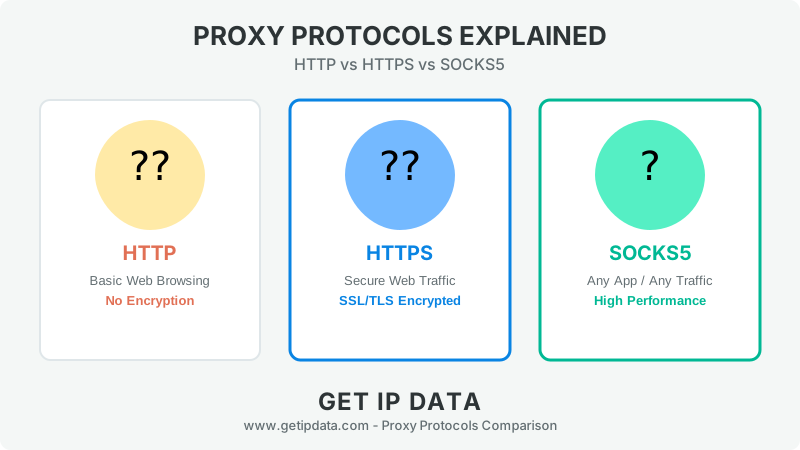
1. HTTP Proxy Protocol HTTP (Hypertext Transfer Protocol) is the most basic proxy protocol. It is specifically designed to handle web traffic (websites starting with http://). When you connect through an HTTP proxy, it reads your web request, fetches the website data, and sends it back to you.
-
Pros: It filters data effectively and can cache web pages to load them faster if accessed multiple times.
-
Cons: HTTP proxies do absolutely nothing to encrypt your data. Your Internet Service Provider (ISP), hackers on public Wi-Fi, or anyone intercepting your connection can see exactly what you are doing in plain text.
-
Best Used For: Basic, non-sensitive web browsing where security is not a concern, or accessing publicly available data that is not geo-blocked.
2. HTTPS Proxy Protocol HTTPS (Hypertext Transfer Protocol Secure) is the upgraded, highly secure version of HTTP. It uses SSL/TLS encryption to create a secure tunnel between your device and the target website.
-
Pros: Total security. Your data is scrambled and encrypted. Even the proxy server itself cannot read the sensitive data (like passwords or credit card numbers) passing through it.
-
Cons: Because it encrypts and decrypts data, it can be marginally slower than a standard HTTP connection. It is also strictly limited to web browser traffic.
-
Best Used For: Web scraping secure websites, online banking, managing social media accounts, and any task where privacy and data security are mandatory.
3. SOCKS5 Proxy Protocol SOCKS5 (Socket Secure version 5) is a completely different beast. Unlike HTTP/HTTPS, which only handle web browser traffic, SOCKS5 handles any type of traffic. It works at a lower level of the internet connection, meaning it can route traffic from any program, application, or game.
SOCKS5 supports both TCP (reliable data transfer) and UDP (fast data streaming) protocols, making it incredibly versatile.
-
Pros: Unmatched flexibility. It can handle email protocols, P2P sharing, gaming traffic, and live video streaming. It is also incredibly fast because it does not read or rewrite the data packets—it just forwards them. SOCKS5 also supports high-level authentication, ensuring only you can use your proxy.
-
Cons: By default, SOCKS5 does not encrypt your data. It hides your IP address perfectly, but unless the application you are using provides its own encryption, the data remains unencrypted.
-
Best Used For: Online gaming, torrenting, live streaming, bypassing strict firewalls, and using applications outside of a web browser (like Telegram or Skype).
Which Protocol Should You Choose? Your choice entirely depends on the software you are using and your primary goal.
If you are building a web scraper to gather public data from standard websites, an HTTPS residential proxy provides the perfect blend of security and compatibility. If your goal is to reduce ping in an online video game, download heavy files, or route a specific software application through a new IP, SOCKS5 is the undisputed champion due to its speed and universal compatibility.